Etymology 
The word Christmas originated as a compound meaning "Christ's mass". It is derived from the Middle English Christemasse and Old English Cristes mæsse, a phrase first recorded in 1038.[4] "Cristes" is from Greek christos and "mæsse" is from Latin missa. In early Greek versions of the New Testament, the letter Χ (chi), is the first letter of Christ. Since the mid-16th century Χ, or the similar Roman letter X, has been used as an abbreviation for Christ.[9] Hence, Xmas is often used as an abbreviation for Christmas.
After the conversion of Anglo-Saxon Britain in the very early 7th century, Christmas was referred to as geol,[4] the name of the pre-Christian winter festival from which the current English word 'Yule' is derived.[10]
History
For many centuries, Christian writers accepted that Christmas was the actual date on which Jesus was born.[11] In the early eighteenth century, scholars began proposing alternative explanations. Isaac Newton argued that the date of Christmas was selected to correspond with the winter solstice,[5] which in ancient times was marked on December 25. In 1743, German Protestant Paul Ernst Jablonski argued Christmas was placed on December 25 to correspond with the Roman solar holiday Dies Natalis Solis Invicti and was therefore a "paganization" that debased the true church.[12] In 1889, Louis Duchesne suggested that the date of Christmas was calculated as nine months after March 25, the traditional date of the conception of Jesus.[13] On the Roman calendar, March 25 was the date of the spring equinox.[14] In modern times, it is celebrated as Annunciation.[15]
Non-Christian celebration

Mosaic of Jesus as Christo Sole(Christ the Sun) in Mausoleum M in the pre-fourth-century necropolis under St Peter's Basilica in Rome.[16] Christians consider Jesus to be the "sun of righteousness" prophesied in Malachi 4:2. A winter festival was the most popular festival of the year in many cultures. Reasons included the fact that less agricultural work needs to be done during the winter, as well as people expecting longer days and shorter nights after the winter solstice in the Northern Hemisphere.[17] Modern Christmas customs include: gift-giving and merrymaking from Roman Saturnalia; greenery, lights, and charity from the Roman New Year; and Yule logs and various foods from Teutonic feasts.[18] Pagan Scandinavia celebrated a winter festival called Yule, held in the late December to early January period. As Northern Europe was the last part to Christianize, its pagan traditions had a major influence on Christmas. Scandinavians still call Christmas Jul. In English, the word Yule is synonymous with Christmas,[19] a usage first recorded in 900.
Dies Natalis Solis Invicti
Dies Natalis Solis Invicti means "the birthday of the unconquered Sun." The use of the title Sol Invictus allowed several solar deities to be worshipped collectively, including Elah-Gabal, a Syrian sun god; Sol, the god of Emperor Aurelian; and Mithras, a soldiers' god of Persian origin.[20] EmperorElagabalus (218–222) introduced the festival, and it reached the height of its popularity under Aurelian, who promoted it as an empire-wide holiday.[21]This day had held no significance in the Roman festive calendar until it was introduced in the third century.[22]
The festival was placed on the date of the solstice because this was on this day that the Sun reversed its southward retreat and proved itself to be "unconquered." Several early Christian writers connected the rebirth of the sun to the birth of Jesus.[4] "O, how wonderfully acted Providence that on that day on which that Sun was born...Christ should be born", Cyprian wrote.[4] John Chrysostom also commented on the connection: "They call it the 'Birthday of the Unconquered'. Who indeed is so unconquered as Our Lord . . .?"[4]
Patristic Developments
The New Testament does not give a date for the birth of Jesus.[23] "There is no month in the year to which respectable authorities have not assigned Christ's birth," according to theCatholic Encyclopedia.[4] Around AD 200, Clement of Alexandria wrote that a group in Egypt celebrated the nativity on Pachon 25.[4] This corresponds to January 6, now Epiphany.[24]Tertullian (d. 220) does not mention Christmas as a major feast day in the Church of Roman Africa.[4] In Chronographai, a reference work published in 221, Sextus Julius Africanussuggested that Jesus was conceived on the spring equinox.[25] The equinox was March 25 on the Roman calendar, so this implies a birth in December.[14]
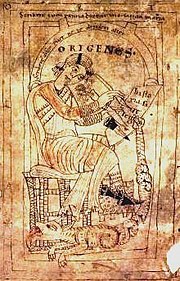
Origen, a father of the Christian church, argued against the celebration birthdays.[26] De Pascha Computus, a calendar of feasts produced in 243, gives March 28 as the date of the nativity.[27] In 245, the theologian Origen of Alexandriastated that, "only sinners (like Pharaoh and Herod)" celebrated their birthdays.[26] In 303, Christian writer Arnobius ridiculed the idea of celebrating the birthdays of gods, which suggests that Christmas was not yet a feast at this time.[4]
Feast established
The earliest reference to the celebration of the nativity on December 25 is found in the Chronography of 354, an illuminated manuscript compiled in Rome in 354.[4][28] In the East, early Christians celebrated the birth of Christ as part of Epiphany (January 6), although this festival focused on thebaptism of Jesus.[29]
Christmas was promoted in the Christian East as part of the revival of Catholicism following the death of the pro-Arian Emperor Valens at the Battle of Adrianople in 378. The feast was introduced to Constantinople in 379, and to Antioch in about 380. The feast disappeared after Gregory of Nazianzusresigned as bishop in 381, although it was reintroduced by John Chrysostom in about 400.[4]
The Twelve Days of Christmas end on January 5. December 26 is St. Stephen's Day and January 6 is Feast of Epiphany This period encompasses the major feasts surrounding the birth of Christ. In the Latin Rite, one week after Christmas Day, January 1, has traditionally been the celebration theFeast of the Naming and Circumcision of Christ, but since Vatican II, this feast has been celebrated as the Solemnity of Mary, Mother of God.
Middle Ages
In the Early Middle Ages, Christmas Day was overshadowed by Epiphany, which in the west focused on the visit of the magi. But the Medieval calendar was dominated by Christmas-related holidays. The forty days before Christmas became the "forty days of St. Martin" (which began on November 11, the feast of St. Martin of Tours), now known as Advent.[30] In Italy, former Saturnalian traditions were attached to Advent.[30] Around the 12th century, these traditions transferred again to the Twelve Days of Christmas (December 26 – January 6); a time that appears in the liturgical calendars as Christmastide or Twelve Holy Days.[30]
The prominence of Christmas Day increased gradually after Charlemagne was crowned Emperor on Christmas Day in 800. King Edmund the Martyr was anointed on Christmas in 855 and King William I of England was crowned on Christmas Day 1066.
By the High Middle Ages, the holiday had become so prominent that chroniclers routinely noted where various magnates celebrated Christmas. King Richard II of England hosted a Christmas feast in 1377 at which twenty-eight oxen and three hundred sheep were eaten.[30] The Yule boar was a common feature of medieval Christmas feasts. Caroling also became popular, and was originally a group of dancers who sang. The group was composed of a lead singer and a ring of dancers that provided the chorus. Various writers of the time condemned caroling as lewd, indicating that the unruly traditions of Saturnalia and Yule may have continued in this form.[30] "Misrule" — drunkenness, promiscuity, gambling — was also an important aspect of the festival. In England, gifts were exchanged on New Year's Day, and there was special Christmas ale.[30]
Christmas during the Middle Ages was a public festival that incorporating ivy, holly, and other evergreens.[31] Christmas gift-giving during the Middle Ages was usually between people with legal relationships, such as tenant and landlord.[31]

Excerpt from Josiah King's The Examination and Trial of Father Christmas (1686), published shortly after Christmas was reinstated as a holy day in England.
Reformation into the 19th century
During the Reformation, some Protestants[who?] condemned Christmas celebration as "trappings of popery" and the "rags of the Beast."[32] The Roman Catholic Church responded by promoting the festival in a more religiously oriented form. Following the Parliamentarian victory over King Charles I during the English Civil War, England's Puritan rulers banned Christmas, in 1647.[32] Pro-Christmas rioting broke out in several cities, and for weeks Canterbury was controlled by the rioters, who decorated doorways with holly and shouted royalist slogans.[32] The Restoration of Charles II in 1660 ended the ban, but many clergymen still disapproved of Christmas celebration.
In Colonial America, the Puritans of New England disapproved of Christmas. Celebration was outlawed in Boston from 1659 to 1681. At the same time, Christian residents of Virginia and New York observed the holiday freely. Pennsylvania German Settlers, pre-eminently theMoravian settlers of Bethlehem, Nazareth and Lititz in Pennsylvania and the Wachovia Settlements in North Carolina, were enthusiastic celebrators of Christmas. The Moravians in Bethlehem had the first Christmas trees in America as well as the first Nativity Scenes. Christmas fell out of favor in the United States after the American Revolution, when it was considered an English custom.[33] George Washington attacked Hessian mercenaries on Christmas during the Battle of Trenton in 1777. (Christmas being much more popular in Germany than in America at this time.) By the 1820s, sectarian tension had eased and British writers, including William Winstanly began to worry that Christmas was dying out. These writers imagined Tudor Christmas as a time of heartfelt celebration, and efforts were made to revive the holiday. Charles Dickens's book A Christmas Carol, published in 1843, played a major role in reinventing Christmas as a holiday emphasizing family, goodwill, and compassion as opposed to communal celebration and hedonistic excess.[34] In America, interest in Christmas was revived in the 1820s by several short stories by Washington Irving which appear in his The Sketch Book of Geoffrey Crayon and "Old Christmas", and by Clement Clarke Moore's 1822 poem A Visit From St. Nicholas (popularly known by its first line: Twas the Night Before Christmas).[35] Irving's stories depicted harmonious warm-hearted holiday traditions he claimed to have observed in England. Although some argue that Irving invented the traditions he describes, they were widely imitated by his American readers. The poem A Visit from Saint Nicholas popularized the tradition of exchanging gifts and seasonal Christmas shopping began to assume economic importance.[36] In her 1850 book "The First Christmas in New England", Harriet Beecher Stowe includes a character who complains that the true meaning of Christmas was lost in a shopping spree.[37] Christmas was declared a United States Federal holiday in 1870, signed into law by President Ulysses S. Grant.
Nativity of Jesus
The Nativity of Jesus refers to the Christian belief that the Messiah was born to the Virgin Mary. The story of Christmas is based on the biblical accounts given in the Gospel of Matthew, namely Matthew 1:18-Matthew 2:12 and the Gospel of Luke, specifically Luke 1:26-Luke 2:40. According to these accounts, Jesus was born to Mary, assisted by her husband Joseph, in the city of Bethlehem. According to popular tradition, the birth took place in a stable, surrounded by farm animals, though neither the stable nor the animals are mentioned in the Biblical accounts. However, a manger is mentioned in Luke 2:7 where it states "She wrapped him in cloths and placed him in a manger, because there was no room for them in the inn." Early iconographic representations of the nativity placed the stable and manger within a cave (located, according to tradition, under the Church of the Nativity in Bethlehem). Shepherds from the fields surrounding Bethlehem were told of the birth by an angel, and were the first to see the child.[38] Many Christians believe that the birth of Jesus fulfilled prophecies from the Old Testament. Many modern scholars view the two Gospel accounts as theological fictions.[39]
Remembering is a central way that Christians celebrate Christmas. There is a very long tradition of the Nativity of Jesus in art. The Eastern Orthodox Church practices the Nativity Fast in anticipation of the birth of Jesus, while much of the Western Church celebrates Advent. In some Christian denominations, children perform plays re-telling the events of the Nativity, or sing carols that reference the event. Some Christians also display a small re-creation of the Nativity, known as a Nativity scene, in their homes, using figurines to portray the key characters of the event. Live Nativity scenes and tableaux vivants are also performed, using actors and live animals to portray the event with more realism.[40]
Nativity scenes traditionally include the Three Wise Men, Balthazar, Melchior, and Caspar, although their names and number are not referred to in the Biblical narrative, who are said to have followed a star, known as the Star of Bethlehem, found Jesus, and presented gifts of gold, frankincense, andmyrrh.[41]
In the U.S., Christmas decorations at public buildings once commonly included Nativity scenes. This practice has led to many lawsuits, as groups such as the American Civil Liberties Union believe it amounts to the government endorsing a religion, which is prohibited by the United States Constitution. In 1984, the U.S. Supreme Court ruled in Lynch vs. Donnelly that a Christmas display (which included a Nativity scene) owned and displayed by the city of Pawtucket, Rhode Island did not violate the First Amendment.[42]
Santa Claus and other bringers of gifts
Main article: Santa Claus
Originating from Western culture, where the holiday is characterized by the exchange of gifts among friends and family members, some of the gifts are attributed to a character called Santa Claus (also known as Father Christmas, Saint Nicholas or St. Nikolaus, Sinterklaas, Kris Kringle, Père Noël, Joulupukki, Babbo Natale, Weihnachtsmann, Saint Basil and Father Frost).
The popular image of Santa Claus was created by the German-American cartoonist Thomas Nast (1840–1902), who drew a new image annually, beginning in 1863. By the 1880s, Nast's Santa had evolved into the form we now recognize. The image was standardized by advertisers in the 1920s.[43]
Father Christmas, who predates the Santa Claus character, was first recorded in the 15th century, but was associated with holiday merrymaking and drunkenness.[44] In Victorian Britain, his image was remade to match that of Santa. The French Père Noël evolved along similar lines, eventually adopting the Santa image. In Italy, Babbo Natale acts as Santa Claus, while La Befana is the bringer of gifts and arrives on the eve of the Epiphany. It is said that La Befana set out to bring the baby Jesus gifts, but got lost along the way. Now, she brings gifts to all children. In some cultures Santa Claus is accompanied by Knecht Ruprecht, or Black Peter. In other versions, elves make the toys. His wife is referred to asMrs. Claus.
The current tradition in several Latin American countries (such as Venezuela) holds that while Santa makes the toys, he then gives them to theBaby Jesus, who is the one who actually delivers them to the children's homes. This story is meant to be a reconciliation between traditionalreligious beliefs and modern day globalization, most notably the iconography of Santa Claus imported from the United States.
In Alto Adige/Südtirol (Italy), Austria, Czech Republic, Southern Germany, Hungary, Liechtenstein, Slovakiaand Switzerland, the Christkind (Ježíšek in Czech, Jézuska in Hungarian and Ježiško in Slovak) brings the presents. The German St. Nikolaus is not identical with the Weihnachtsman (who is the German version of Santa Claus). St. Nikolaus wears a bishop's dress and still brings small gifts (usually candies, nuts and fruits) on December 6 and is accompanied by Knecht Ruprecht. Although many parents around the world routinely teach their children about Santa Claus and other gift bringers, some have come to reject this practice, considering it deceptive.[45]
Christmas tree and other decorations
Main article: Christmas tree

A Christmas tree ornament. The Christmas tree is often explained as a Christianization of pagan tradition and ritual surrounding the Winter Solstice, which included the use of evergreen boughs, and an adaptation of pagan tree worship.[46] The English language phrase "Christmas tree" is first recorded in 1835[44] and represents an importation from the German language. The modern Christmas tree tradition is believed to have begun in Germany in the 18th century[46] though many argue that Martin Luther began the tradition in the 16th century.[47][48] From Germany the custom was introduced to England, first via Queen Charlotte, wife of George III, and then more successfully by Prince Albertduring the reign of Queen Victoria. Around the same time, German immigrants introduced the custom into the United States.[49] Christmas trees may be decorated with lights and ornaments.
Since the 19th century, the poinsettia has been associated with Christmas. Other popular holiday plants includeholly, mistletoe, red amaryllis, and Christmas cactus. Along with a Christmas tree, the interior of a home may be decorated with these plants, along with garlands and evergreen foliage.
In Australia, North and South America, and to a lesser extent Europe, it is traditional to decorate the outside of houses with lights and sometimes with illuminated sleighs, snowmen, and other Christmas figures. Municipalities often sponsor decorations as well. Christmas banners may be hung fromstreet lights and Christmas trees placed in the town square.[50]
In the Western world, rolls of brightly colored paper with secular or religious Christmas motifs are manufactured for the purpose of wrapping gifts. The display of Christmas villages has also become a tradition in many homes during this season. Other traditional decorations include bells, candles, candy canes, stockings, wreaths, and angels.
Christmas decorations are traditionally taken down on Twelfth Night, the evening of January 5.
The traditional colours of Christmas are pine green (evergreen), snow white, and heart red.
Christmas stamps
A number of nations have issued commemorative stamps at Christmastime. Postal customers will often use these stamps for the mailing ofChristmas cards, and they are popular with philatelists. These stamps are regular postage stamps, unlike Christmas seals, and are valid for postage year-round. They usually go on sale some time between early October and early December, and are printed in considerable quantities.
In 1898 a Canadian stamp was issued to mark the inauguration of the Imperial Penny Postage rate. The stamp features a map of the globe and bears an inscription "XMAS 1898" at the bottom. In 1937, Austria issued two "Christmas greeting stamps" featuring a rose and the signs of the zodiac. In 1939, Brazil issued four semi-postal stamps with designs featuring the three kings and a star of Bethlehem, an angel and child, the Southern Crossand a child, and a mother and child.
The US Postal Service regularly issues both a religious-themed and a secular-themed stamp each year.
Economics of Christmas

Christmas display in a Brazilian shopping mall. - See also: Christmas in the media, Christmas tree production, Christmas tree cultivation, and Christmas Price Index
Christmas is typically the largest annual economic stimulus for many nations. Sales increase dramatically in almost all retail areas and shops introduce new products as people purchase gifts, decorations, and supplies. In the U.S., the "Christmas shopping season" generally begins on Black Friday, the day after Thanksgiving, though many American stores begin selling Christmas items as early as October.[51] In Canada, merchants begin advertising campaigns just before Halloween (October 31), and step up their marketing following Remembrance Day on November 11.
In most areas, Christmas Day is the least active day of the year for business and commerce; almost all retail, commercial and institutional businesses are closed, and almost all industries cease activity (more than any other day of the year). In England and Wales, the Christmas Day (Trading) Act 2004 prevents all large shops from trading on Christmas Day. Scotland is currently planning similar legislation. Film studios release many high-budget movies in the holiday season, including Christmas films, fantasy movies or high-tone dramas with high production values.
An economists analysis calculates that Christmas is a deadweight loss under orthodox microeconomic theory, due to the surge in gift-giving. This loss is calculated as the difference between what the gift giver spent on the item and what the gift receiver would have paid for the item. It is estimated that in 2001 Christmas resulted in a $4 billion deadweight loss in the U.S. alone.[52][53] Because of complicating factors, this analysis is sometimes used to discuss possible flaws in current microeconomic theory. Other deadweight losses include the effects of Christmas on the environment and the fact that material gifts are often perceived as white elephants, imposing cost for upkeep and storage and contributing to clutter.[54]
Controversy
Books
- Christmas in America: A History, by Penne L. Restad (New York: Oxford University Press, 1995). ISBN 0-19-509300-3
- The Battle for Christmas, by Stephen Nissenbaum (1996; New York: Vintage Books, 1997). ISBN 0-679-74038-4
- The Origins of Christmas, by Joseph F. Kelly (August 2004: Liturgical Press) ISBN 978-0814629840
- Christmas Customs and Traditions, by Clement A. Miles (1976: Dover Publications) ISBN 978-0486233543
- The World Encyclopedia of Christmas, by Gerry Bowler (October 2004: McClelland & Stewart) ISBN 978-0771015359
- Santa Claus: A Biography, by Gerry Bowler (November 2007: McClelland & Stewart) ISBN 978-0771016684
- There Really Is a Santa Claus: The History of St. Nicholas & Christmas Holiday Traditions, by William J. Federer (December 2002: Amerisearch) ISBN 978-0965355742
- St. Nicholas: A Closer Look at Christmas, by Jim Rosenthal (July 2006: Nelson Reference) ISBN 1418504076
- Just say Noel: A History of Christmas from the Nativity to the Nineties, by David Comfort (November 1995: Fireside) ISBN 978-0684800578
- 4000 Years of Christmas: A Gift from the Ages, by Earl W. Count (November 1997: Ulysses Press) ISBN 978-1569750872
- The Birth of Christ", by Peter Sammons (May 2006: Glory to Glory Publications) (UK) ISBN 0-9551790-1-7
- ที่มาhttp://en.wikipedia.org/wiki/Christmas


.jpg)